You've Been Conditioned to Check Your Email. It's Time to Stop.
· By Matt Senter
A red badge appears on the mail icon. Your stomach tightens. You stop what you were doing, swipe over, and find a calendar invite, a marketing newsletter you forgot you signed up for, and a "thanks!" reply from someone you emailed last Tuesday.
Nothing in there needed you. But your nervous system already responded as if it did.
This is conditioning, not productivity
Every notification is a small bet. Most of the time, it's nothing. Occasionally, it's something important. That intermittent reward is exactly the schedule that makes a behavior stick, and it's the same mechanic that powers slot machines.
Over years, your brain has learned a simple rule: new email could mean something urgent, so check it now. You don't decide to check anymore. You just check. In line at the coffee shop. In the middle of a meeting. Three seconds after you sat down to focus.
The problem isn't your discipline. The problem is the premise. You're acting on an assumption that hasn't been true for a long time.
90% of your email is not for you (right now)
Open your inbox honestly and count. Receipts. Shipping confirmations. Calendar replies. Newsletters. Cold pitches. Status updates from tools you signed up for. Notifications about notifications.
Maybe one message in ten actually wants something from you. Of those, maybe one in ten genuinely needs an answer in the next hour. The rest can wait. They always could.
And yet every one of them triggers the same alert, the same badge, the same little tug of urgency. The medium treats them all as equal. That's the part we want to change.
Your inbox should respect your time
Here's a different premise to try on:
- Your inbox is a place you visit, not a place that interrupts you.
- When you do visit, only the things that need you should be there.
- Everything else has a home, just not the home that demands attention.
That's it. That's the whole reframe. Inboxes are for actionable items. Folders and labels are for postponing things gracefully, or for surfacing the small set of senders that genuinely outrank everything else.
A well-tended rules system does the sorting for you
The way to keep an inbox honest is to maintain it like a garden. Most categories of email belong somewhere other than the front page:
- Receipts and confirmations go to a Receipts folder. You'll want them at tax time, not now.
- Newsletters go to a Reading folder. Read them on a Sunday morning with coffee, not during a sprint.
- Notifications from tools go to a Notifications folder. Skim them on your terms.
- Cold outreach and recruiter spam go to Quarantine. Look when you're curious, not when you're trying to think.
- Calendar replies and routine acknowledgements auto-archive. You don't need to see "thanks!" land in your inbox.
The catch is that maintaining all of those rules by hand is its own full-time job. Senders change. Subject lines drift. You eventually give up and the inbox swallows everything again. This is the part AI is actually good at: looking at each message and deciding, message by message, which bucket it belongs in.
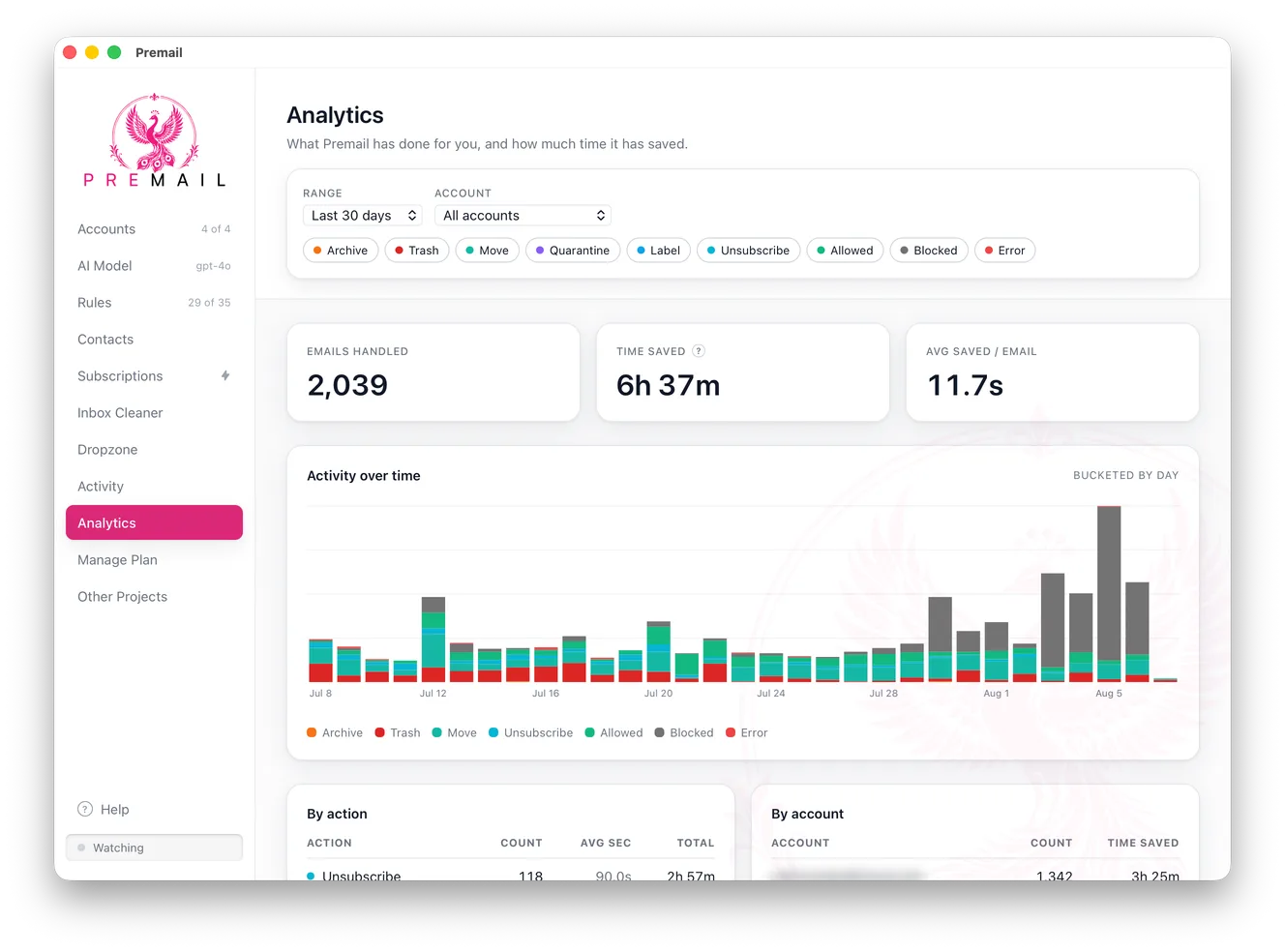
That's what Premail does. You describe the kinds of things you care about, and the rules apply themselves to every new message, quietly, in the background, before you ever see it.
It is going to be okay
The hardest part of this isn't technical. It's emotional. You've been trained for years to believe that an unchecked inbox is dangerous. That something important is sitting there, and the longer you wait, the worse the consequences.
It's almost never true. Real emergencies don't come by email. The people who actually need you right now will call, text, or walk over. Everything in your inbox can wait an hour, or four, or until tomorrow morning, and the world will keep turning.
Try it once. Close your mail app at 9am. Don't reopen it until lunch. Notice that nothing collapsed. Notice the little dopamine reach for your phone and decline it. Do it again the next day. After a week, the urge softens. After a month, you'll wonder how you ever lived the other way.
Take back your inbox
You don't have to keep responding to a notification system designed to capture your attention. You can decide, deliberately, when you want to look at your email and what you want to see when you do.
Turn off the badges. Turn off the sounds. Build a rules system that does the triage for you, so the only messages that land in your inbox are the ones that actually want your attention. Then visit your inbox like you'd visit a mailbox, on your schedule, and walk away when you're done.
That's what your inbox should feel like. Calm. Quiet. Small. Yours. Folders and arrival rules that make the inbox small enough to visit on a schedule are in how to organize your email inbox.